This little corner of France is packed with UNESCO world heritage sites. After Avignon and Pont du Gare, Arles makes the third.
No more than a twenty minute train ride from Avignon, Arles was founded by Julius Caesar. Augustus, first Emperor of Rome then began building many of the monuments that remain today.
Upon arrival I made my way straight to the main attraction (at least the one that I knew existed), the amphitheater.
Standing at the heart of Arles, it is the 20th largest arena in the Roman world. By the middle ages the townsfolk dismantled the seating and used the interior as an inhabited fortified district of the town. Eventually the houses were demolished and restoration began on the amphitheater in the 19th century.
Today, whilst missing a few limbs, it stands proud over the town. Between the modern seating feral cats wondered around or slept in the shade. The tourists? Few and far between in this town.
Next to the amphitheater stands the theatre. Where in the former, gladiators and chariots would fight to the death, in the theatre the arts took precedent.
Once standing as tall as it’s neighbour, it has been almost entirely demolished by medieval citizens for building materials. Now, all thats left is the lower ranks of seats, some remaining exterior arches, and bits of carved stone piled around the sides of the site. It is a sad affair to look upon what must have been the Royal Albert Hall of its day. Sadly time has swept it away.
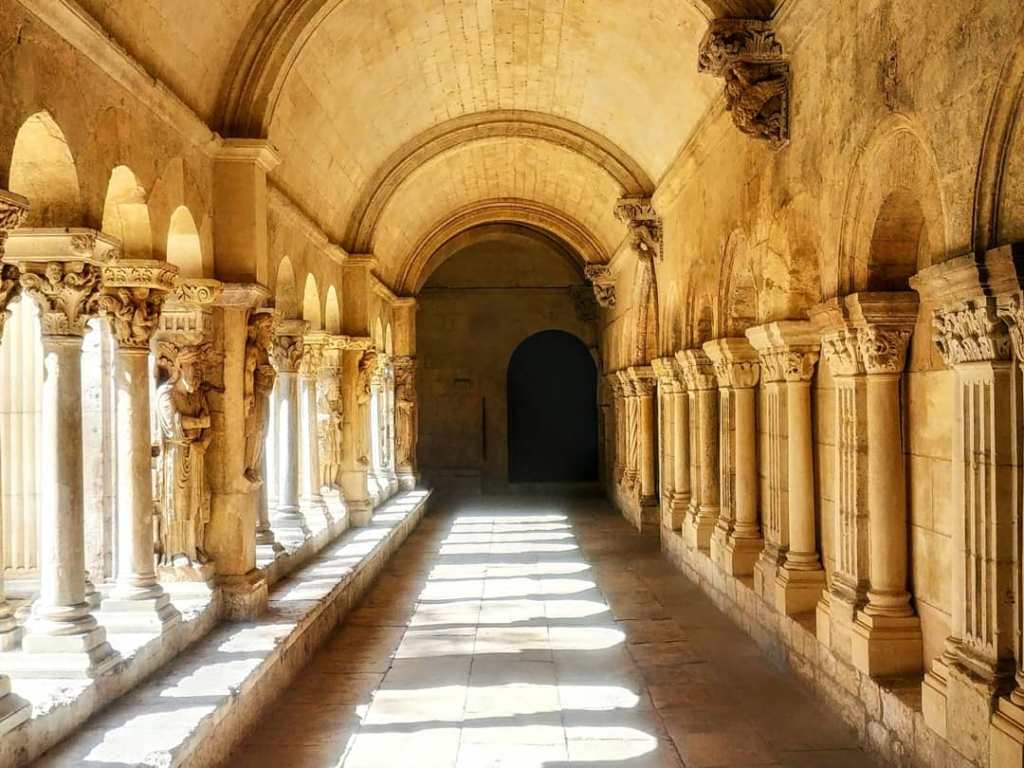
The third site is not Roman but was built from the 12th century to the 14th. The facade of the Church of Saint-Tristome, somehow unscathed by over 800 years of wear and tear is a breathtaking achievement of 12th century stone carving. Likewise it’s cloister, built half in the romanesque style and half in gothic, puts detail front and centre. There’s no other way to describe it than beautiful.
Next up beneath the city is the vast remains of the Cryptoportiques. These are the foundations, built as two tunnels connected by arches, that held up the Porticos of the Roman forum above.
Almost perfectly preserved these tunnels are long, giving you a sense of just how large the forum above used to be. Well worth the descent underground.
No time to stop there I made my way to the Roman baths. Once covering a land area of 3700 square metres, only 1100 square metres remains. Like the amphitheater, the people of arles cannibalised and built home into and within the Roman structure. As such much of the original building has been lost over the centuries. What remains today though is still an impressive site covering two of the former bathing rooms. Most impressive was the restored wall and half dome on one side of the building, towering above the floor. Of course a written description is poor substitute for the real thing so definitely put Arles on your bucket list!
The final part of the UNESCO site was Alychamp. Once a sprawling Roman and medieval necropolis now all that remains is one avenue of empty tombs terminated by the medieval St Honorat’s Church. Painted by Van Gogh this remant of cemetary was a pleasant walk. Once again the ravages of time (and people) have reduced it from its former glory. Nontheless like all historic sites, their value is no less, simply because they are physically diminished.
I capped off my trip to arles by a muse through the antiquities Museum which features a 2000 year old Roman river barge and some enormous Roman floor mosaics. The museum building may have been horribly modern for my taste but the contents were anything but.
So ends another epic day in my travels.
 All Aboard The Backpacker's Express